



APPLE PODCAST | SPOTIFY | OTHER PLATFORMS
The question used to be simple. Should you start a podcast? And the answer was almost always yes. But after years of watching service providers burn out, stop publishing, and walk away from shows that were working, it’s clear that the real question was never about whether to start a podcast. It was about what business problem you’re trying to solve, and whether a weekly public show is really the right tool to solve it.
That shift in thinking leads directly to the weekly podcast vs limited series podcast conversation, and it’s one that not enough people are having.
Start With the Business Goal, Not the Format
Different goals require different tools. A service provider who wants to stay consistently visible and build an ongoing relationship with a growing audience has different needs than someone who wants a specific, contained experience that walks a potential client from first impression to ready-to-hire. Those are not the same goal, and they don’t require the same format.
So before deciding on any audio experience, the right starting place is three questions.
What business outcome are you trying to create?
Who needs to hear what you have to say?
And what type of audio experience would best serve that audience, and you?
Everything else, the format, the length, the publishing cadence, gets decided after those three questions are answered.
What a Weekly Podcast Is Good For
A weekly podcast makes sense when you love showing up consistently with new ideas, when you want an ongoing relationship with your audience, and when you’re willing to commit to a regular publishing schedule over the long term. It’s also the right fit if you want to build something that grows and compounds over time, attracting new listeners through search while deepening trust with the ones who keep coming back.
It’s a format built for an ongoing conversation. You’re not trying to take someone through a specific journey in a defined number of episodes. You’re building a body of work, week after week, that lets people hear how you think across a wide range of topics, angles, and ideas.
If that sounds like what you want, a weekly podcast is still a powerful choice. Nothing about that has changed.
What a Strategic Limited Series Podcast Is Good For
A strategic limited series podcast is something different. Instead of committing to an ongoing publishing schedule, you create a defined set of episodes, typically somewhere between eight and twelve, with a clear beginning, middle, and end. Every episode has a purpose. Every episode answers the next question a potential client might need answered before she’s ready to work with you.
The goal of a limited series is to take someone on a decision journey. She finds you, she starts listening, and by the time she reaches the final episode, she has heard your philosophy, your framework, your process, your perspective on the problem she’s trying to solve, and what it looks like to work with you. You’ve addressed her objections. You’ve shifted her thinking. You’ve let her spend real time with your voice.
And you did all of that without recording a new episode every week.
This format works especially well for service providers who are deep in client work and don’t have the bandwidth for a weekly commitment, for those who have pivoted and need content that reflects where their business is now, and for anyone who wants the trust-building benefits of audio without the ongoing production demands of a public show.
Public vs Private: How a Limited Series Gets Delivered
A limited series can be delivered two ways, and the distinction matters.
A public limited series lives on Apple Podcasts and Spotify like any other show. Anyone can find it through search. With the right SEO in place, a potential client who has never heard of you can stumble across it looking for answers to a problem you solve, start listening, and work through all ten episodes before she ever sees your website. The discoverability is a real advantage.
A private limited series requires an opt-in. Someone gives you their email address to access it, which means every listener is on your list. This works beautifully as a lead magnet, as a pre-discovery-call experience, or as a way to walk a warm lead through your full process before she books a call. The trade-off is that she has to find out it exists before she can access it, so it requires a bit more active promotion.
The strategy is the same either way. What changes is how you distribute it, and how you capture the relationship.
How to Know Which One You Need
A weekly podcast is probably the right fit if you want an ongoing, evolving conversation with your audience and you’re willing to show up consistently over time.
A strategic limited series is probably the right fit if you want something intentional and contained that walks a potential client through your full process, if you don’t want or can’t sustain a weekly commitment, or if you want the benefits of audio working for your business without adding another recurring task to your week.
And podcast guesting, showing up on other people’s shows to borrow their audience and bring new listeners into your world, is worth considering as a starting point if you’re newer, if you’ve recently pivoted, or if you want to build visibility before committing to your own show. The one thing to have in place before guesting is somewhere to send people once they want to hear more from you.
The Bigger Shift
What’s changed is not a belief in podcasting. Audio is still the most powerful tool a service provider has for compressing the time between someone finding her and someone trusting her enough to reach out. That hasn’t changed.
What has changed is the assumption that every service provider needs the same version of it. Your business is not the same as anyone else’s. Your audience isn’t the same. Your schedule, your offers, your goals, the way you want to show up, none of it is the same. So why would the solution be exactly the same for everyone?
It doesn’t have to be. And if you’ve been waiting to start something because weekly felt like too much, or you’ve had a show that didn’t fit the way you work, there may be a format that fits better than anything you’ve tried so far.
If you want to talk through what that could look like for your specific business, you can book a 30-minute call at allisonnitsch.com/chat. And if getting on a call isn’t your thing right now, there’s a form on that same page where you can send your questions and go from there.
🎧 FREE RESOURCE
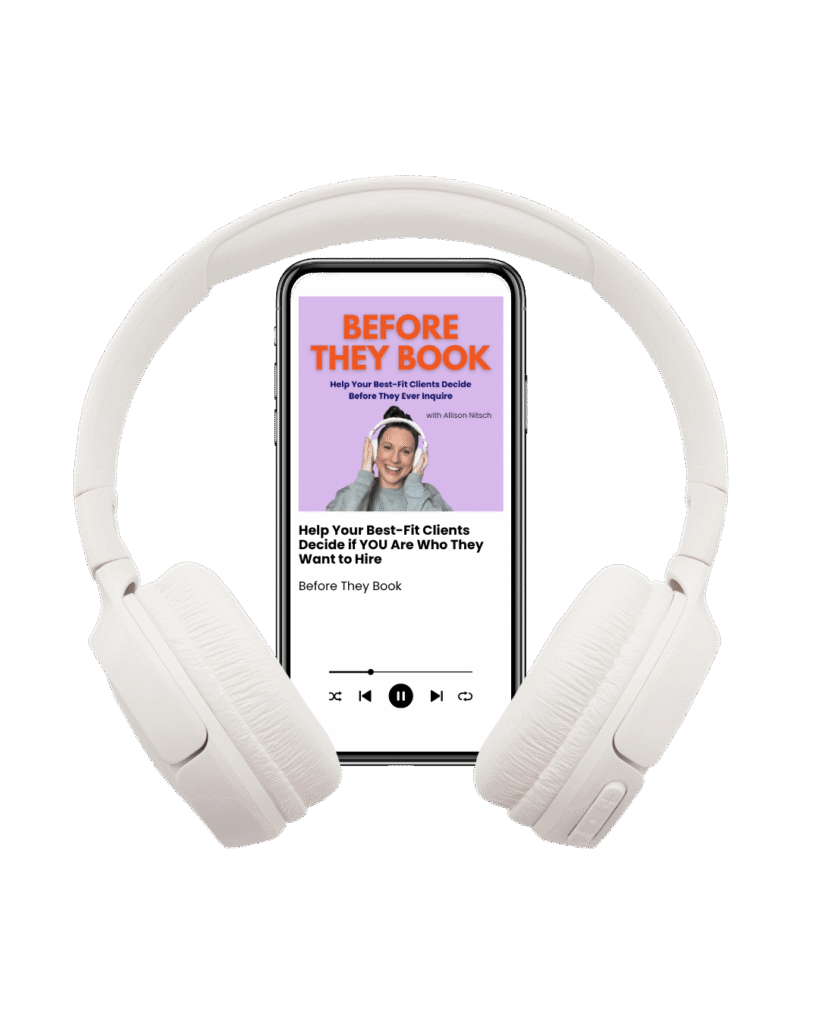
Listen to Before They Book is my free 8-part private podcast that walks through exactly how to use audio to help potential clients understand your work and decide whether they’re ready to hire you. The podcast itself is an example of what I’m teaching you to create. Listen here.
🎙️ WORK WITH ALLISON
If you want an audio experience built for your business that helps potential clients say yes, the Private Podcast Experience is where we do that together. We figure out what your potential clients need to hear, map their decision journey, and turn it into one intentional private podcast designed to help the right people say yes. Learn more here.
📲 CONNECT
Website – allisonnitsch.com
Instagram – @allisonnitsch
Threads – follow here
🛠️ PODCAST/MARKETING TOOLS I USE
Captivate – podcast hosting, 7-day free trial
Descript – recording and editing
Showit – website platform
Flodesk – email marketing
*Some links are affiliate links – I earn a small commission at no cost to you.

LEAVE A COMMENT